Sam Trenholme’s blog
Capa720: A Chess Variant proposal
February 7, 2026
Capablanca Chess is a family of (usually 8x10) Chess variants where the board is 8 files high but 10 files wide, and the usual Chess setup has rook + knight (C) and bishop + knight (A) fairy pieces added to the starting array.The king moves three squares instead of two when castling.
If the rook remains in the corners, and the king in the center, and if the bishops are on opposite colors, we have some 720 possible opening setups (compared to 18 setups when we have the king in the center and the rooks in the corners in Classic Chess).
I call this set of opening setups Capa720, a family of some 720 different Chess variants.
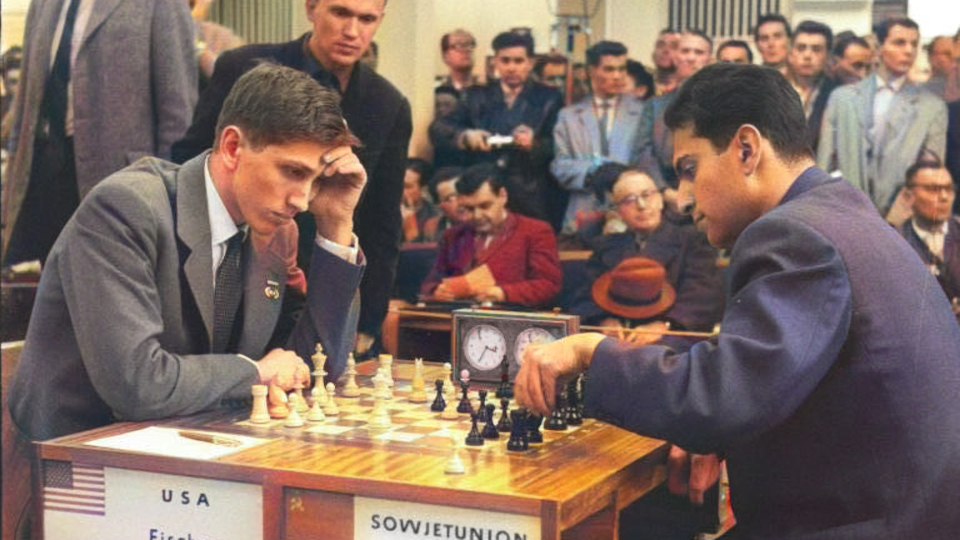
Pictured above are two world champions, Bobby Fischer (left) and Mikhail Tal (right) playing a famous 1960 game which ended in a draw; I discuss a Chess variant rule change which would result in fewer draws later on in this blog entry.
Improving Capablanca Chess
The problem with Capablanca Chess is this: The game greatly reduces draws, but this is because the game is a win for White; analysis indicates, that with perfect play, White always wins.
There are two ways to give Black better chances in Capablanca Chess:
-
Changing the opening setup. One Trice originally proposed lowering White’s advantage by carefully choosing a balanced opening setup.1
-
“Pie rule”: Player one chooses White’s first move, and player two chooses whether to play White or Black.2
Let’s look at these two proposals.
Changing the opening setup
Back in the first 2000s decade, many members of the then Chess Variant community looked at a large number of possible opening setups. Here are the proposed setups with names which I listed back in 2008:3
Setup           Name               21-ply score
--------------  -----------------  ------------
RBANCKNQBR*     Grotesque          24
RNABCKBQNR*     Finesse            24
RNBQCKABNR      Gothic             27
RNBAQKCBNR      Capa 1             29
RNABQKBCNR      Capa 2             36
RBCNAKNQBR*     Landorean          36
RQNBAKBNCR      Schoolbook         39
RNQBCKBANR      Blackbook          40
RNCBQKBANR      Nalls              40
RBNCQKANBR      Univers            40
RANBQKBNCR      Aberg              43
RNBACKQBNR      Embassy            45
RCNBAKBNQR*     Notebook           47
RNBQAKCBNR      Teutonic           49
RCNBQKBNAR      Carrera            54
RANBCKBNQR*     Narcotic           58
RNBCAKQBNR*     Consulate          60
RNBCQKABNR      Bird               62
* The 2008 setup was a mirror image
The setup is the initial array for both Black and White; C is rook + knight and A is knight + bishop. The name is the name given to the setup back in 2008. The 21-ply score is White’s advantage, in centipawns (100 centipawns is a 1-pawn advantage).
The best setups (where White has less than a 24-centipawn advantage) are:
Setup      21-ply score
---------- ------------
RNBBNKCQAR 17 (h2-h4)
RABNNKCBQR 20 (d1-e3)
RCNBNKAQBR 21 (b1-c3)
RBNANKBCQR 21 (h2-h3)
RNNBQKCABR 22 (b1-c3)
RNABNKQCBR 22 (d2-d4)
RNABBKNQCR 22 (e2-e4)
RABBNKNCQR 23 (d2-d4)
RABNNKQBCR 23 (d2-d4)
RNBBQKNCAR 23 (e2-e4)
RNABNKBQCR 23 (f2-f4)
RBBCNKNQAR 23 (g1-f3)
RNABCKQNBR 23 (h1-i3)
RBCNAKBQNR 23 (h2-h4)
RBBNCKAQNR 23 (i1-h3)
Here we see the setup, White’s centipawn advantage, and also the move White should make to have that advantage.
The setups where White has a 24 centipawn advantage are RNBBAKCQNR, RNBBQKCNAR, RBANCKNQBR (Grotesque), RNCBNKAQBR, RNABCKBQNR (Finesse), RBANCKQNBR, and RNCBBKNAQR.
The three worst setups, with a significant advantage for White, are RQNBCKBNAR (92 centipawns), RAQNBKCBNR (96), and finally RQNABKCBNR (Where white has a 99 centipawn advantage).
The point being that carefully choosing the opening setup where White has the minimum advantage reduces White’s advantage from around 35 centipawns to, at most, 17 centipawns. White still has an edge.
Indeed, if we play 500 games of Finesse Chess (RNABCKBQNR) at 18-ply depth (this game has a 24 centipawn advantage for White in our 21-ply analysis), we get these results:
500 games played
White 238 47.6%
Draw   89 17.8%
Black 173 34.6%
13% White winning edge
56.5% White score
57.9075% White decisive wins
So, of the 500 games played, White won 238, 89 were draws, and Black won 173. If we look at only decisive games where either White or Black wins, White won 57.9% of those games.
Compare this to Classic Chess:
White 142 28.4%
Draw  258 51.6%
Black 100 20%
500 games played
8.4% White winning edge
54.2% White score
58.6777% White decisive wins
Point being, with a carefully chosen opening setup for Capablanca Chess, we can reduce White’s advantage to be roughly White’s advantage in Classic Chess (58.7% decisive games won in Classic Chess, 57.9% in Finesse Chess). Since Chess players are happy with White’s edge in Classic Chess, maybe they would be happy with having the same edge for White in Finesse Chess, while greatly reducing draws.
Maybe not. Let’s look at another way of reducing White’s advantage.
The Pie Rule
We can essentially eliminate White’s edge with the Pie rule.
With the Pie Rule, player one chooses White’s first move, and then player two chooses whether he4 is White or Black. To get a sense of what a Pie Rule game would look like, let’s look at some good Pie Rule moves for White in Classic Chess, where neither White nor Black have a significant advantage. The edge for White is shown in centipawns.
Move   White edge
------ ----------
Nc3    0
c3     2
a3     3
d3     -6
Enough master games of Chess have been played that we can see how the Baltic Opening (1. Nc3), Anderssen Opening (1. a3), Saragossa Opening (1. c3), and Mieses Opening (1. d3) play out. 1. a3 is in particular a very interesting opening, because it stops Black from playing a reversed Ruy Lopez (1. a3 e5 2. e4 Nf6 3. Nc3 Bb4?? and now White takes the bishop) and gives White his tempo back in many reversed Sicilian setups (e.g. 1. a3 e5 2. c4 Nf6 3. d3 d5 4. cxd5 Nxd5 5. Nf3 Nc6 and now it’s a reversed Najforf where White has a tempo because he played a3 on the first move and doesn’t have to play 6. a3).
The big advantage of the Pie Rule is that it eliminates White’s edge while minimizing the chances of the game being a forced win for Black. Of the 720 Capa720 setups played, some 490 setups have 1 or more first moves for White which perfectly balance the game (0 centipawn advantage for White). Even with the very unbalanced RQNABKCBNR starting position, where White has a nearly one pawn advantage, in Pie Rule, we can balance the position by having White’s first move be one of 1. h4 or 1. Ch3.
While the Pie Rule is a blunt tool for balancing an unbalanced abstract game, it is also very effective at removing the first player advantage.
Now that we have a way of reducing White’s edge, is there a way we can make Chess less drawish?
Ko rule
In this famous 1960 game, Tal forces a draw
One way we can make a drawish game, like Chess, less drawish is to have a version of the “Ko Rule”, where it is not permitted to have a previously played position repeated; if a given move repeats a previously played position, another move has to be made which creates a position not seen yet in the game being played. If a player cannot make a legal move without repeating a previously played position, they lose.
This makes some classic games of Chess, such as the hard fought draw in 1960 where Fischer played against then reigning World Champion Tal,5 not possible—but it also makes Chess a lot less drawish.6
Initial testing with Classic Chess and Finesse Chess shows that draws are greatly reduced with this rule change. Here is a 12-ply tourney played with Ko Rule Classic Chess:
White 240 48%
Draw   92 18.4%
Black 168 33.6%
500 games played
14.4% White winning edge
57.2% White score
58.8235% White decisive wins
And with Finesse Chess:
White 1287 51.48%
Draw    58  2.32%
Black 1155 46.2%
2500 games played
5.28% White winning edge
52.64% White score
52.7027% White decisive wins
Capa720: A proposal
Let me propose Pie Rule Capa720:
-
We choose one of the 720 Capa720 setups at random
-
Player #1 chooses White’s first move
-
Player #2 gets to decide whether to be White or Black
No opening book, minimum draws (and if 20% draws is too much, we can always also have the Ko rule), and a lot of possibilities for very tactical dynamic games.
The research used to make this blog entry can be seen here:
Picture attribution
Taken by Ulrich Kohls in 1960. Provided by Deutsches Bundesarchiv. License: CC-BY-SA 3.0 DE Altered: Cropped, enlarged, and finally colorized (colors chosen by DeepAI with slight manual tweaking).
Footnotes
1: https:/
2: New Rules for Classic Games, 1992, page 25
3: https:/
4: Or she! Judit Polgar recently defeated World Champion Magnus Carlsen in a famous 2022 Skittles Game that they played
5: https:/
6: The game would had ended with a win for Fischer against Tal, something Fischer did not achieve until the following year in the real world